

The Panama Canal is one of the most crucial maritime routes for international trade, facilitating the transit of goods between the Atlantic and Pacific Oceans.
However, its infrastructure, based on a water-dependent lock system, is facing a crisis due to the prolonged drought in the region.
This situation is causing delays in maritime transport, increasing logistics costs and affecting both international companies and the global economy.
What is an international channel and why is it key in global trade?
In international trade , the competitiveness of countries depends on factors such as the distance between markets , logistics infrastructure , and the ability to generate economies of scale that reduce export and import costs.
In this context, international channels play a key role in the efficiency of maritime transport.
International canals , such as the Suez Canal and the Panama Canal , are artificial waterways that connect two bodies of water, allowing ships to shorten distances and reduce transit times.
These routes are considered "choke points" due to their strategic importance for global trade.
Its operation directly influences logistics costs , the availability of goods, and the stability of international supply chains.
Why the Panama Canal is key to international trade
The Panama Canal is one of the world's most strategic maritime routes, facilitating approximately 6% of global trade.
This route, managed by an autonomous entity of the Panamanian government , connects 1.920 ports in 170 countries through 180 maritime routes , allowing for reduced transit times, distances and logistics costs.
The main user of the Panama Canal is the United States , which accounts for about 67% of the total cargo transported.
The most important routes that cross this interoceanic route include:
- US East Coast – Asia
- East Coast of the USA – West Coast of South America
- US East Coast – Central America West Coast
- Europe – West Coast of South America
- Asia – East Coast of Central America
Without the Panama Canal , the countries on the west coast of South America , which export to Europe, the US and Canada , would face the "tyranny of distance" , losing international competitiveness and severely affecting their economies.
This would not only impact global trade, but would also have repercussions on the development of globalization and the efficiency of international supply chains.
How the Panama Canal works and its impact on international trade
The Panama Canal , which connects the Atlantic and Pacific Oceans , has a key difference compared to other strategic canals, such as the Suez Canal , which temporarily collapsed in 2021 and jeopardized the global supply chain.
Unlike this, the Panama Canal operates with fresh water , making it dependent on rainfall and climate change.
This canal operates through a system of locks , which allows ships to be raised several meters above sea level to cross Gatun Lake , an artificial body of water that connects both oceans.
This lake is fed by the Chagres River , whose water comes from local rainfall in the province of Panama. As long as there is sufficient rainfall , the canal remains operational without problems.
However, during periods of prolonged drought , such as the current one, the water level in Lake Gatun drops, which severely impacts maritime traffic.
In addition, with each ship that crosses, the canal loses millions of liters of water due to its own operating system.
To put it in perspective, each of the 12.000 ships that transit the canal annually needs around 200 million liters of water to complete the crossing.
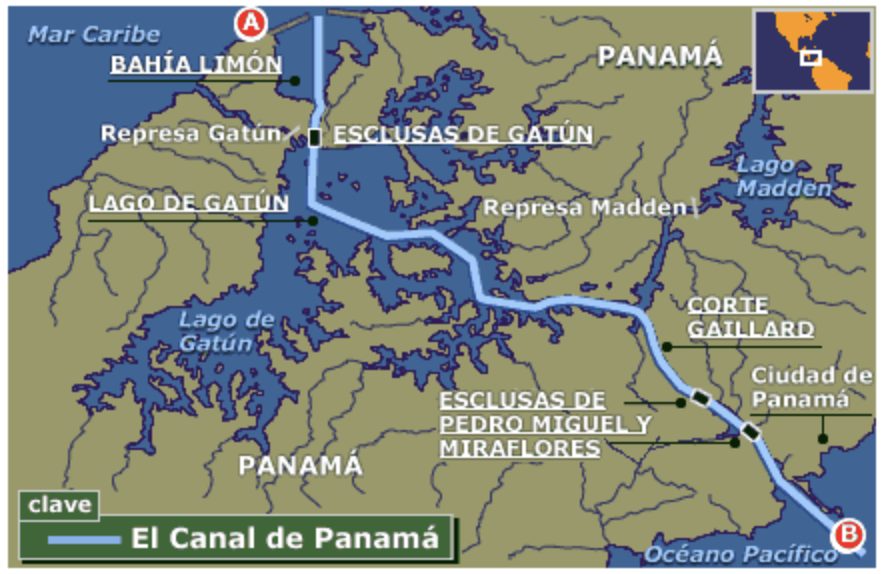
Therefore, when the levels of Lake Gatun drop, the authorities must restrict traffic , affecting thousands of businesses that depend on this route for their commercial operations.
Currently, the Panama Canal is facing a partial reduction in its traffic , which is causing delays in global maritime transport , increased logistics costs , and adjustments in international supply chains.
Crisis in the Panama Canal: what is happening and how it affects global trade
Currently, the Panama Canal Authority has imposed restrictions on maritime traffic due to the drought crisis affecting the region.
To ensure the operability of the waterway, the maximum depth of container ships has been limited and the number of ships that can cross daily has been reduced.
As a result, ships face a wait of up to 21 days before they can continue their route, with more than 120 vessels on the waiting list.
Furthermore, ships that manage to transit must do so with less cargo , which reduces the revenue of the Panama Canal itself , since the fees are calculated based on the weight transported.
This directly impacts the revenues of the Panamanian administration and the profitability of international maritime trade.
Economic impact: increased costs and pressure on the supply chain
The economic consequence of these restrictions is significant.
Pressure on the global supply chain is increasing, forcing many exporting and importing companies to seek alternative routes.
These options, such as transit through the Suez Canal or going around South America , involve higher logistical costs , which are inevitably passed on to consumers.
In a context of global inflation , this crisis in international trade may cause an increase in the price of products , especially in a key period such as the last quarter of the year , when demand is high due to the Christmas season.
This could affect the availability and cost of essential goods, generating an economic impact across multiple sectors.
Impact of drought on the Panama Canal: delays, costs and logistics crisis
The combination of extreme drought and restrictions on maritime traffic has created a breeding ground for a global economic crisis from the point of view of demand and supply chain.
In the case of Panama , the situation is even more delicate, since the Panama Canal represents about 7% of its GDP.
This new challenge comes in a context where international trade has not yet recovered from the impact of the COVID-19 pandemic , nor from other factors such as global inflation , the conflict in Ukraine , the collapse of the Suez Canal in 2021 , and the slowdown of the world economy.
Furthermore, the peak shopping season — coinciding with the return from vacation and Christmas shopping — could be severely affected by the partial blockade of the Panama Canal , generating supply problems and price increases in key sectors.
Will the door be opened to a new canal in Nicaragua?
In the face of this crisis, a key geopolitical question arises: will China and Nicaragua take advantage of this situation to revive the Nicaragua Canal project?
This megaproject, announced in 2012 with Chinese support, aimed to compete with the Panama Canal by offering an alternative route for global maritime trade.
The project has so far been on hold, but the current crisis could revive its strategic interest.
As in the field of International Relations , global trade has proven to be resilient , overcoming crises such as the pandemic without completely halting globalization.
However, uncertainty remains and the decisions of the main international players will have to be observed.
Conclusion: The legal and business impact of the crisis in the Panama Canal
The current crisis in the Panama Canal not only represents a logistical challenge for companies, but also has legal and strategic implications for international trade.
Companies affected by increased costs, route reconfiguration, and supply chain delays must evaluate their commercial contracts , transport agreements, and export and import strategies to mitigate risks and ensure their competitiveness.
How can an international trade lawyer help you?
At RRYP Global , we are an international law firm in Spain specializing in legal advice for international companies.
If your company faces international legal challenges, we can help you:
- Review and renegotiate international contracts affected by delays and additional costs.
- Advise you on international trade strategies to optimize your logistics and minimize risks.
- Managing contractual disputes and regulatory compliance in global operations.

Contact RRYP Global and get expert advice to navigate this complex economic scenario.
📩 Request a consultation here.