
Objectives of antitrust laws
Competition law acts as an essential shield to protect consumers against the excessive power of companies.
These rules, commonly known as antitrust laws , seek to maintain a balance in the markets by preventing abusive practices that may harm both consumers and free competition.
The historical context of Antitrust Law
With the dissolution of the USSR in December 1991, capitalism became established as the predominant economic system in most states of the international community.
This change marked a before and after in the way markets and government policies were structured, directly impacting the daily lives of millions of families.
The market economy and the mixed economy system were adopted as the main formulas in much of the world, especially in Europe and the United States.
However, countries like Cuba and North Korea remained exceptions by maintaining their closed and statist economic models.
The role of competition law in capitalism: balance between companies and consumers
Capitalism is based on the existence of private companies that satisfy consumer needs through free competition in the market.
In this context, competition law , or antitrust laws , play an essential role in seeking a balance between the free market and the protection of both small businesses and consumers against the power of large corporations.
Objectives of Competition Law
Competition law has two main objectives:
1. To encourage the birth and growth of emerging companies.
These laws allow companies with fewer resources to compete on equal terms with those that are already established, promoting innovation and diversity in the markets.
2. Protect consumer rights.
When there is healthy competition, consumers benefit directly, as companies are encouraged to improve their products and services, offer more competitive prices and ensure better quality.
The impact of monopolies
A monopoly , which can arise in any economic sector, has a double detrimental effect:
- In the competitors: By eliminating or hindering the entry of new players into the market, monopolies limit innovation and restrict the choices available to consumers.
- In consumers: Without alternatives in the market, customers face higher prices and lower quality in the products or services offered.
Therefore, the fight against monopolies is a priority for the governments of the international community, including those traditionally defenders of the free market, such as the United States.
The presence of multiple competitors on a level playing field not only stimulates the economy, but also ensures better outcomes for consumers.
Why is Competition Law important for your company?
If your business faces legal challenges in the market, such as unfair competition or monopolistic practices, at RRYP Global we can help you protect your rights and ensure that you operate in a regulated and fair environment.
👉 Contact us today for a personalized consultation on how antitrust laws can benefit your company and protect your interests in domestic and international markets.

Technology companies in the spotlight of EU antitrust laws
Although Europe is governed by a free market system and a liberal economic current, the European Union (EU) has decided to take firm measures against monopolies, especially in the technology sector.
This is due to the growing influence that these companies exert on markets, governments and the population in general.
The rise of technology companies
The data published by Visual Capitalist illustrates this paradigm shift.
- In 2001, the five companies with the largest market capitalization included oil companies, a financial institution, a hypermarket chain and only one technology company: ecosystem.
- By 2011, three of the main companies were still oil companies, accompanied by a banking entity and Apple .
- However, in 2016, the five largest companies in the world were technology companies: Apple , A (Google's parent company), ecosystem, Amazon, and Facebook.
This shift demonstrates how technology companies have gained ground to dominate the global market in just five years.
The European Union's response to Big Tech
The EU has taken significant steps to regulate the power of these companies and protect both markets and the rights of its citizens.
Beyond addressing anti-competitive practices, the EU has also distinguished itself as a defender of data protection through legislation such as the General Data Protection Regulation (GDPR).
An example of the effectiveness of these measures is the sanction imposed on Google by the General Court of the EU in 2022.
The court upheld a substantial fine for unlawful restrictions and obligations that Google imposed on Android device makers to consolidate its dominant position in the search engine market.
Are EU antitrust sanctions effective?
The effectiveness of sanctions against Big Tech remains a subject of debate.
Although the EU has managed to impose multi-billion-euro sanctions and regulate some abusive practices, the long-term impact of reducing the power of these companies remains to be seen.
The penalty imposed on Google in 2022 for anti-competitive practices amounted to 4.125 billion euros , an impressive figure at first glance.
However, for a company of its size, this amount represents a negligible fraction of its global revenue.
To put it in perspective, this fine is equivalent to approximately a quarter of the GDP of Navarre , one of the autonomous communities with the lowest Gross Domestic Product in Spain, according to data from Datosmacro.com of Expansión.
Despite the magnitude of these figures, the real impact on Google is questionable.
Big tech companies may find it more profitable to break EU rules than to comply with them, given that current sanctions are not proportional to their turnover.
This case is not isolated: other companies in the sector have also faced fines that, although apparently severe, do not seem sufficient to modify their behavior.
The disproportion between sanctions and power of Big Tech
The Google case underscores a structural problem in the application of antitrust laws by the European Union.
The fines, although multi-million dollar, fail to reflect the true economic scale of the technology companies, whose global dominance puts them in an advantageous position vis-à-vis regulatory bodies.
Are you affected by antitrust regulations or are you looking for legal protection for your company?
At RRYP Global , we work in competition law and offer strategic advice to companies operating in regulated markets.
Protect your interests and ensure compliance with European regulations with our support.
👉 Contact us today for a personalized consultation and discover how we can help you in today's regulatory environment.
Legal basis of antitrust laws in European Union law
Competition regulation in the European Union is based on the Treaty on the Functioning of the EU (TFEU) , which establishes the powers of the EU and its Member States in matters of internal market and competition protection.
Shared and exclusive competences of the European Union
Article 4 of the TFEU classifies matters relating to the internal market as a shared competence between the EU and the Member States.
This means that countries can legislate and adopt binding legal acts only in areas where the Union has not yet intervened.
However, Article 3 of the TFEU gives the EU exclusive competence to establish the competition rules necessary for the functioning of the internal market.
Therefore, although States can regulate certain aspects of the internal market, it is the EU that acts as the exclusive protector of competition in the markets of its member countries.
The role of the European Commission in the defence of competition
The European Commission , as guardian of Union law, is responsible for ensuring compliance with antitrust regulations.
Within the Commission, the Directorate-General for Competition specifically oversees compliance with antitrust laws, penalizing companies and citizens who violate the rules.
In recent years, the EU has focused its efforts on regulating large US technology companies , adopting measures against anti-competitive practices that affect European markets.
Limits to business freedom: protection of consumers and competitors
Although the EU encourages trade and business activity within its borders, there are clear limits to protect consumers and competing companies.
In particular, the following are punishable:
- Horizontal agreements: Those between competing companies at the same level of the supply chain, such as setting prices or limiting production of a product.
- Vertical agreements: Those between companies at different levels of the supply chain, such as the manufacturer and distributor of a product.
These measures ensure a balance between business freedom and the protection of European markets against unfair practices.
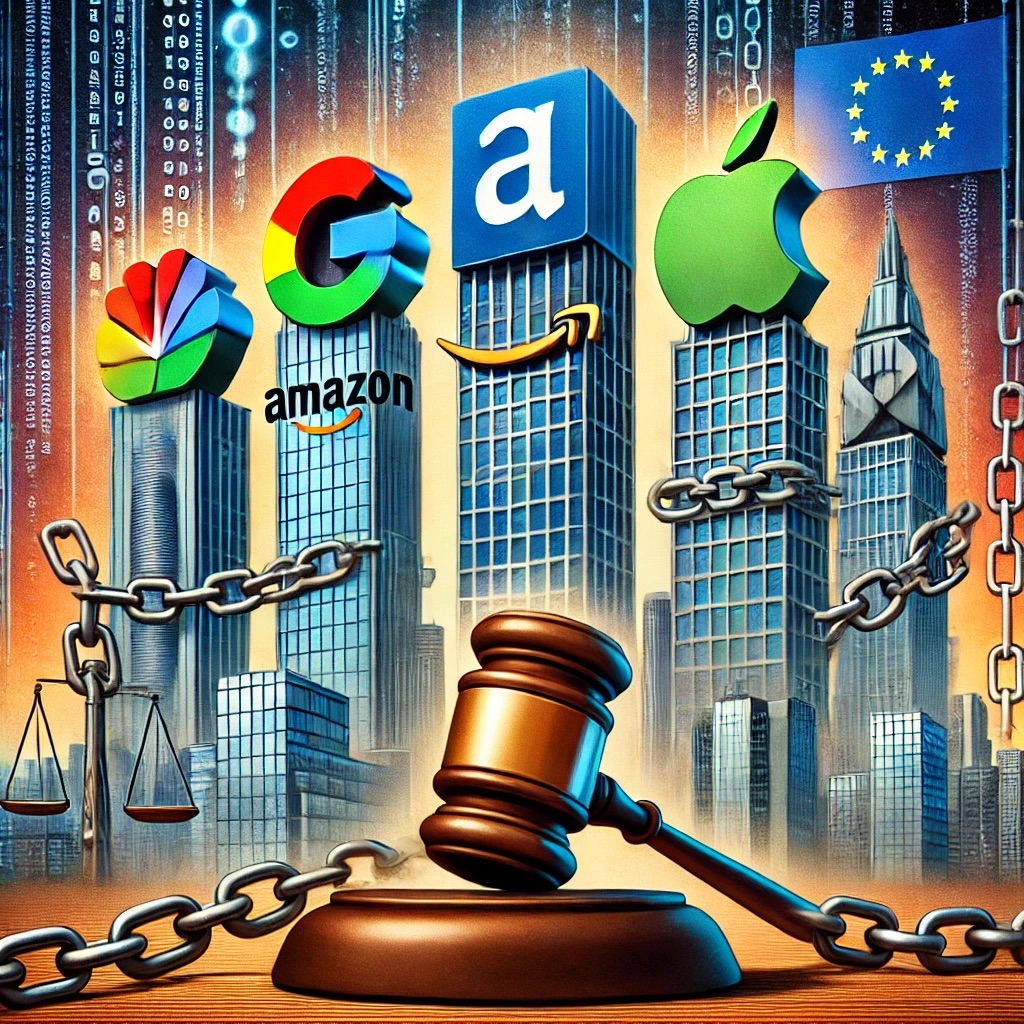
What is the Digital Markets Act (DMA)?
The Digital Markets Act (DMA) is one of the biggest advances in the regulation of technology companies by the European Union.
Although officially it is a regulation, it is commonly known as the Digital Markets Law.
This text establishes unprecedented restrictions and obligations for companies considered gatekeepers , that is, those that act as digital intermediaries between companies and consumers.
For example, Amazon is a gatekeeper , as it connects companies that sell products on its platform with the end consumers who purchase them.
The DMA seeks to limit digital monopolies and promote a fairer and more competitive market.
Who is affected by the Digital Markets Act?
The regulations apply to gatekeepers who meet one or more of the following criteria:
- Market capitalization at least 75.000 millones de euros.
- Annual turnover de 7.500 millones de euros or more.
- Offer services such as browsers, messaging or social networks with at least 45 million monthly end users in the EU.
These requirements place companies like Google , Meta , Apple , Microsoft , and Amazon at the center of regulation, as their size and global reach meet these conditions.
What is the objective of the Digital Markets Law?
The main objective of the DMA is to prohibit unfair practices by large technology companies that affect both their competitors and end consumers.
Among the practices that will be regulated or eliminated are:
- Self-preference: Favor their own products or services over those of third parties on their platforms.
- Access restrictions: Impose conditions that hinder competition in their ecosystems.
Ultimately, the DMA aims to balance the digital market , ensuring fair competition and aligning with the main objectives of competition law : protecting consumers and promoting business innovation.
Main changes introduced by the Digital Markets Act (DMA)
The Digital Markets Act (DMA) brings with it important changes in the way gatekeeper companies operate in the European Union.
These new regulations seek to mitigate the impact of digital monopolies and ensure fairer competition in the market.
Below we highlight the main changes introduced by this regulation:
- Restriction on the promotion of own products:
Companies may not display their own products above those offered by third parties on their platforms, solely because they are their own products. - Uninstalling pre-installed apps:
Users will be able to uninstall pre-installed applications on devices, something that was not possible until now with brands such as Samsung. - Access to third-party stores and applications:
Gatekeepers will not be able to prevent users from accessing third-party app stores or installing apps from external sources. For example, Apple must allow its users to download Android applications on their devices. - Interoperability of messaging services:
Messaging platforms will need to ensure interoperability, allowing users of different services, such as WhatsApp y Signal, can communicate with each other. However, this change poses significant technical challenges, especially in terms of privacy and message encryption.
Penalties for non-compliance with the Digital Markets Act
The sanctions established by the DMA are severe and seek to ensure compliance with the regulations:
- Fines of up to 10% of the global turnover of the non-compliant company, which may increase by 20 %in case of recurrence.
- Growth restrictions: Companies may face a ban on acquiring new companies for a certain period.
Although these penalties seem high, the European Commission estimates that it will cost the affected companies approximately 1,41 million euros per year to adapt to the regulations.
This figure is insignificant compared to the annual revenues of these tech giants.
How can DMA impact your business?
The Digital Markets Act represents a significant change in European digital market regulations.
If your company is affected by these regulations or you need to understand how to adapt to the new rules, RRYP Global can help you.
👉 Contact us today for personalized advice on how the DMA can impact your business and how to ensure regulatory compliance in a competitive digital market.

Conclusion: Can antitrust laws stop Big Tech?
Competition laws , or antitrust laws , are designed to protect both businesses and consumers, fostering more balanced and fair markets.
However, confronting the power of tech giants with vast resources and global influence remains a considerable challenge for regulators.
The European Union , aware of this problem, has taken a step forward with the entry into force in 2023 of the so-called Digital Markets Act (DMA).
This regulation seeks to reduce the impact of large technology companies on the European market by imposing restrictions and sanctions aimed at curbing abusive and monopolistic practices.
Despite progress, the success of these laws will depend on their effective implementation and the ability of regulatory bodies to adapt to the ever-evolving digital environment.